
Home

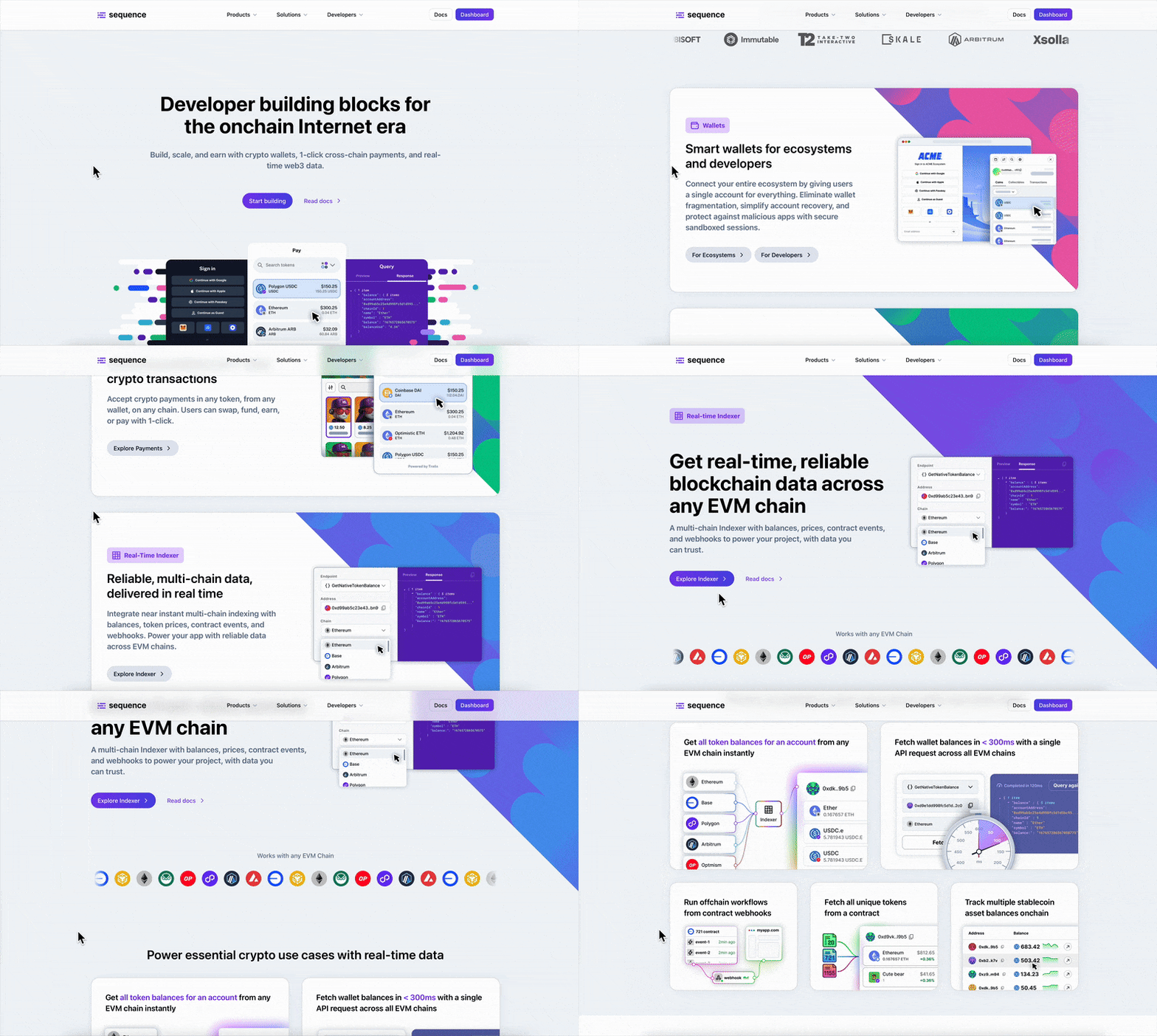
Repositioning Sequence GTM Strategy
Repositioning Sequence from a Web3 gaming brand to a developer-first infrastructure platform
Overview
Sequence needed to shift from a gaming-focused brand to a developer-first Web3 infrastructure platform. Although we offered powerful tools like wallets, payments, and data APIs, many still saw us as a “Web3 gaming company,” which confused users and limited partnerships.
I led a UX and strategy redesign to clarify our story, simplify the product structure, and refresh the brand. The result positioned Sequence as a trusted infrastructure platform for developers and partners alike.
My role
- Product design leadership
- User Research
- UI/UX Design
- Interaction Design
- Branding
- Testing
Scope
- Remote team
- Implementation constraints
- 2 months from discovery to delivery
Discovery
Realizing the perception gap
As we gathered feedback from partners and prospects a clear pattern emerged: people didn’t fully understand what Sequence was. Some saw us as a gaming studio, others just as a wallet provider. Even internally, the product story was fragmented. It was clear that our brand and website no longer reflected the company’s evolution into a full Web3 infrastructure platform.
Working with key stakeholders like leadership, BD, and product teams, I mapped the perception issues and identified their impact on business goals. I decided to investigate the gap through usability testing and competitive research.
Fresh first impressions from users
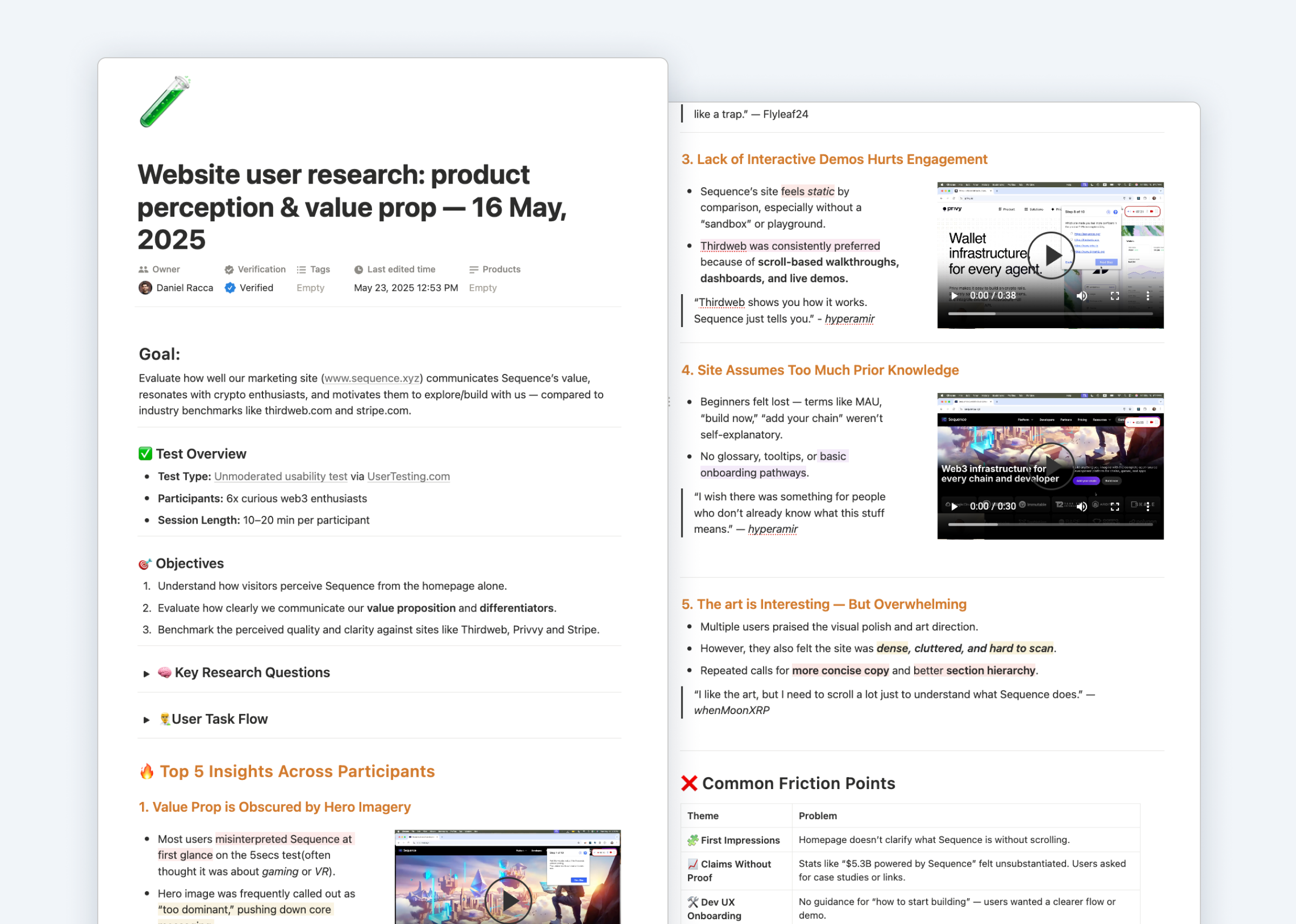
We ran usability tests with six Web3-curious developers on UserTesting.com to see how people perceived our website and value proposition. Each participant shared first impressions and explored our website comparing it with competitors like Thirdweb and Stripe. The goal was to uncover how clearly we communicated our purpose and where users felt lost or skeptical.
⭐ Value added: The findings gave us clear direction on how to improve clarity, trust, and engagement across messaging and structure.
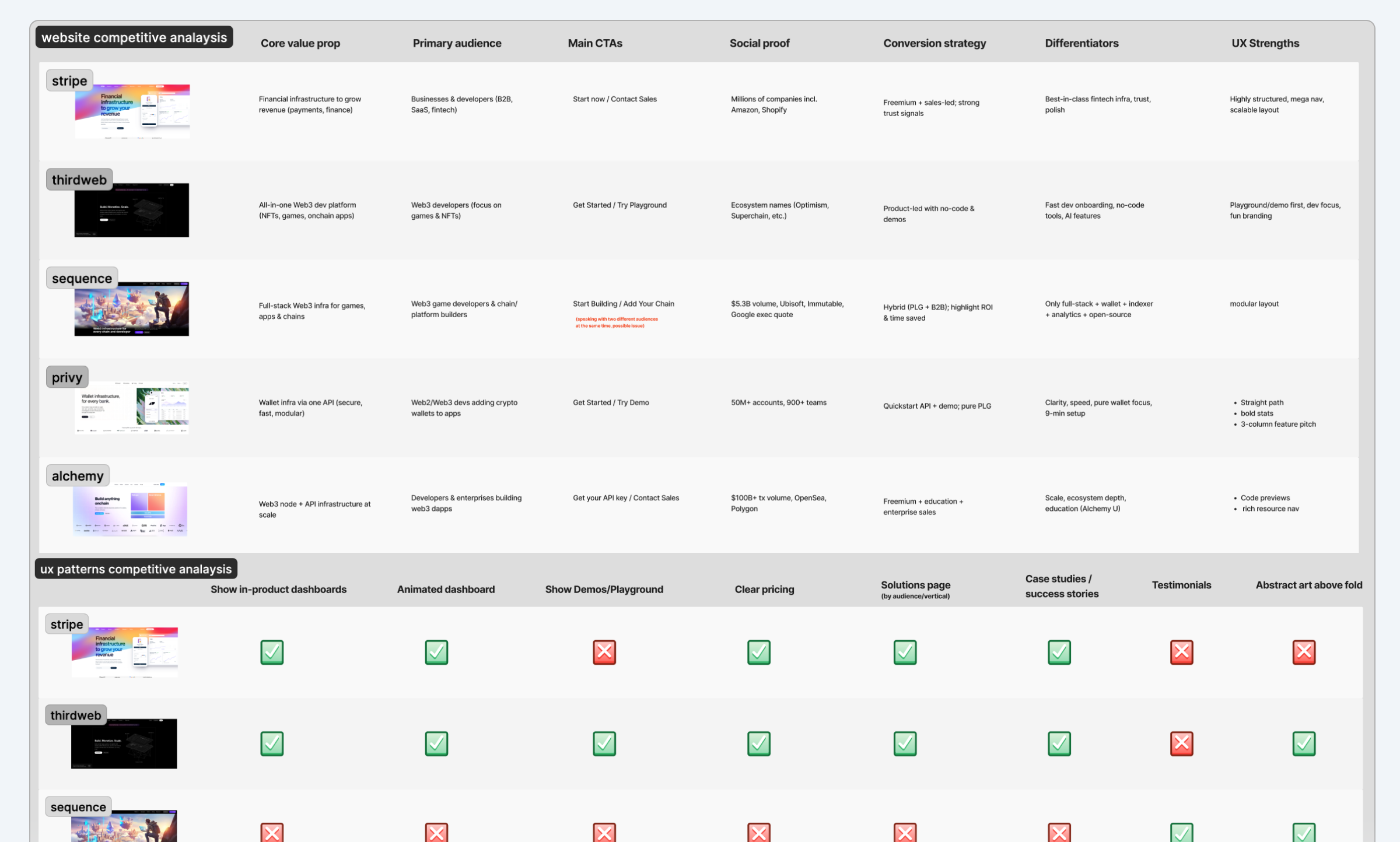
Top insights
- Most users thought Sequence was for gaming or VR.
- “Custom pricing” felt suspicious and reduced trust.
- Lack of demos made the product feel abstract.
- Technical jargon confused newer developers.
- Beautiful visuals, but too much art buried the message.
Defining
Through workshops with leadership and product, we aligned on a new direction.
Defining the problem:
”How might we reposition Sequence so users, partners, and the team share the same understanding of what we offer?”
Strategic Goals
- Reposition Sequence as Web3 infrastructure, not a gaming platform.
- Simplify the product stack into three primary products (Wallets, Payments, Indexer.)
- Reframe communication by verticals: (Gaming, Stablecoins/DeFi, Chains, Fintech)
- Rebuild trust through proof, clarity, and transparency.
We also classified everything into primary vs. secondary products, cutting communication noise and helping the org focus its storytelling. This became the foundation of the new information architecture.
Designing
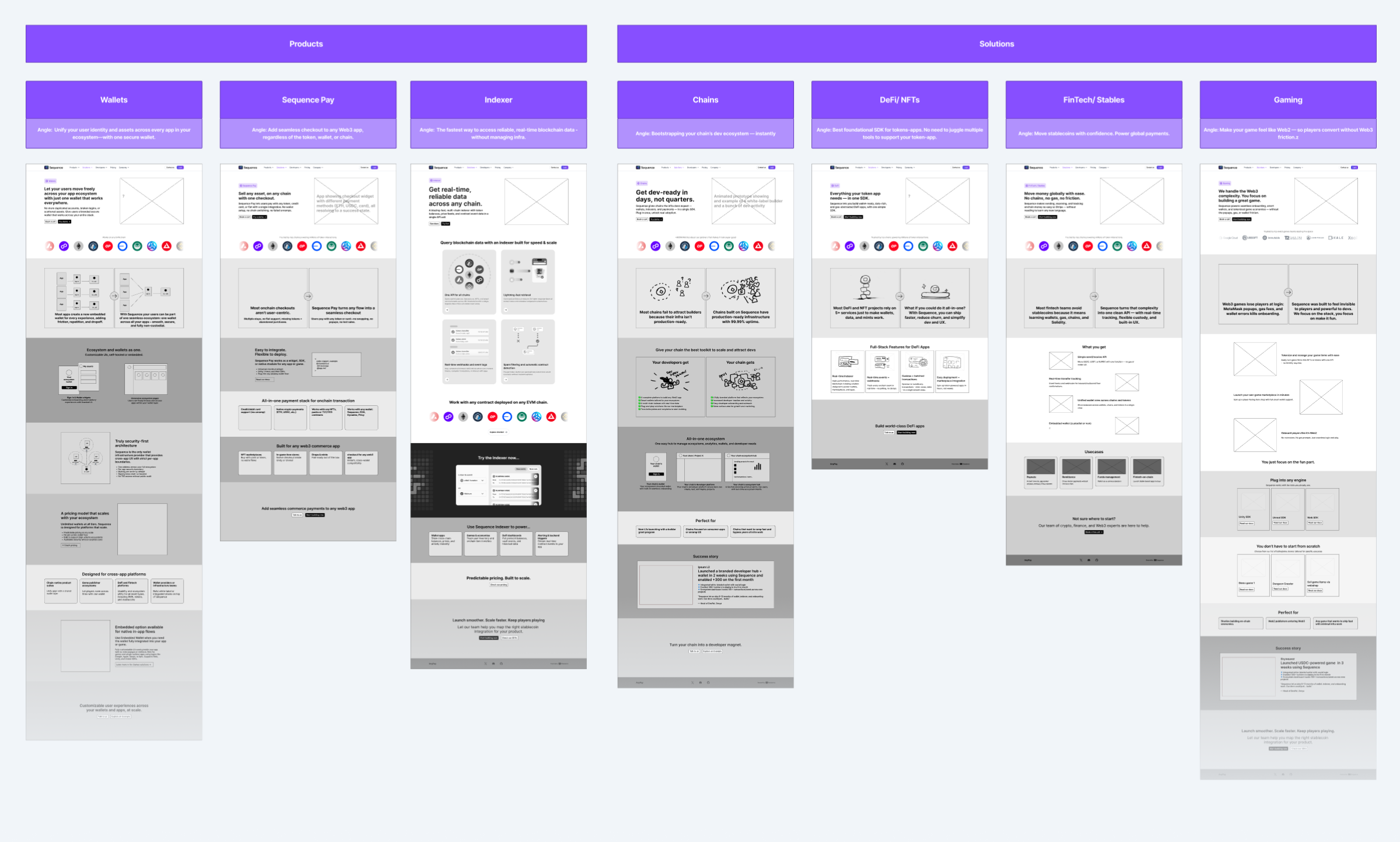
I designed wireframes with clear messaging, outcome-driven CTAs, and modular layouts for different verticals. Copy began with AI drafts and was refined with PMs and leadership to sharpen tone and clarity.
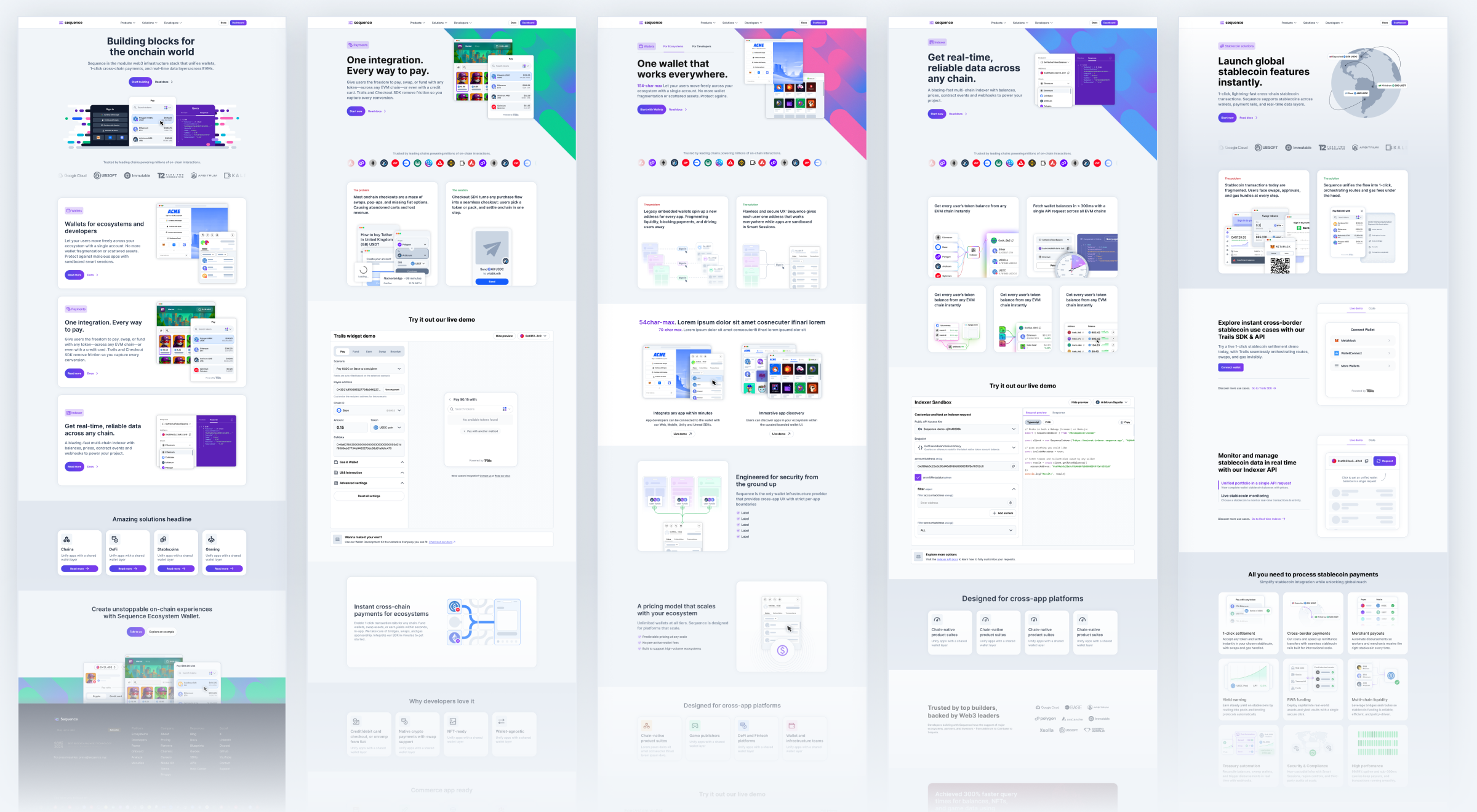
The visual direction shifted from a dark, gaming-inspired look to a light, enterprise-focused identity.
I simplified the logo for clarity, replaced abstract art with real product screenshots, and unified system diagrams to build a cleaner, more trustworthy visual language.
Delivery
We shipped a lean MVP in just two weeks, focusing on clarity over completeness to unlock key partnerships. Several partners required a redesigned site and a simpler product narrative before committing, so speed and focus were critical.
I led design QA alongside engineers to ensure implementation quality and defined a post-launch roadmap that would include the entire specs defined at the beginning of the project.
Outcomes
The project didn’t just change how we communicate our product, it changed how we think strategically about the future of the company.
3+
Major deals Polygon, Katana, Arbitrum
🎉
Ultimately this project contributed to Sequence getting acquired by Polygon.
Reflections
Clarity is a design problem.
When users misunderstand you, it’s not just marketing — it’s UX.
Design can drive strategy.
The process started as a website redesign but led to company-wide alignment on what Sequence actually is.
Show, don't tell.
When users misunderstand you, it’s not just marketing — it’s UX.
Thank you for reading :)
Back to home